

- Countertops
Quartz Countertop Ideas: What Grand Rapids Kitchens Are Choosing
September 16, 2026
By DeHaan Tile & Floor Covering Team
Walk through a slab yard in West Michigan right now and you will notice something. The bright white quartz with flat gray veins that dominated kitchens for the past decade is not what people point at anymore. They want depth. Movement. Something that looks like it came out of the ground instead of off a printer.
That shift shows up clearly in the countertops DeHaan’s design team has pulled for Grand Rapids kitchens this fall. DeHaan has fitted West Michigan kitchens since 1963, long enough to watch trends come and go, and this one has more staying power than most. Here is what is actually trending for early 2027. Here is also what to consider before you commit to a slab that photographs well but does not age well in your kitchen. Book a free design consultation at our Division Avenue showroom to see these colors against your own cabinets first.
What You’ll Learn in This Article
- Why Grand Rapids Kitchens Are Moving Past Uniform-Looking Quartz
- What Quartz Colors and Patterns Are Actually Trending Right Now?
- Is the Countersplash Look Worth It in a West Michigan Kitchen?
- How Do You Pick a Quartz Color That Will Still Look Good in 10 Years?
- Cambria, Vicostone, or Viatera: Which Brand Has the Colors You Want?
Key Takeaways
- Realistic, natural-stone-look veining is replacing the flat, pixelated quartz patterns that were common a few years ago.
- Deeper, moodier colors and warm neutrals are both trending in 2026 kitchens, and they are not opposites. Many Grand Rapids homeowners are pairing a darker island with a lighter perimeter.
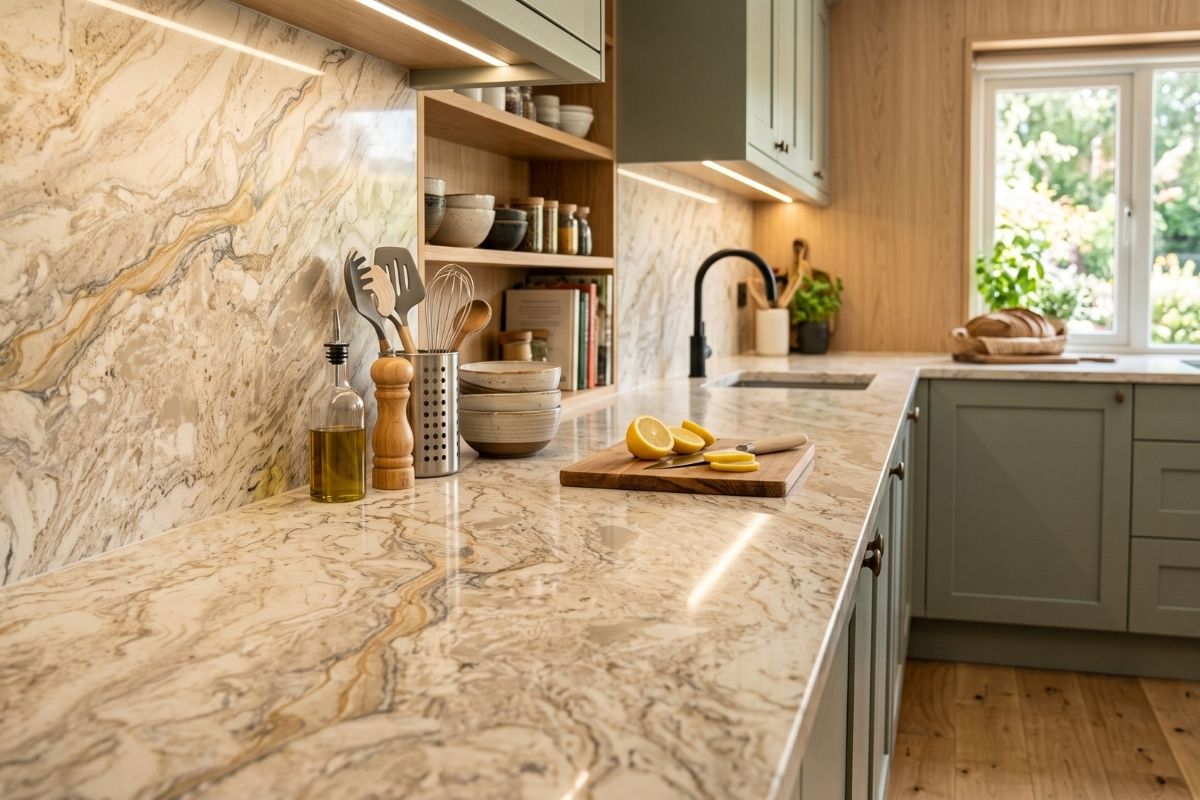
- The “countersplash” technique, running the same quartz slab from counter to backsplash, is gaining traction in Ada, Forest Hills, and Cascade kitchen remodels.
- Quartz does not require sealing, unlike natural stone, but heat resistance still varies by product line, which matters when comparing brands.
- DeHaan Tile & Floor Covering carries Cambria, Vicostone, and Viatera, so Grand Rapids homeowners can compare trend colors across all three at one Division Avenue showroom visit.
- A quartz color chosen for a trend photo can clash with a kitchen’s real cabinets and lighting. An in-showroom side-by-side beats a Pinterest board.
Why Grand Rapids Kitchens Are Moving Past Uniform-Looking Quartz
Homeowners are done with quartz that looks manufactured. That shift shows up in national design coverage through 2026, and in what DeHaan’s showroom has pulled for Grand Rapids kitchens this fall.
For years, the easiest quartz to manufacture was also the most common: bright white with thin, repeating gray veins. It photographed well online. In person, under the warm undertones common in older Grand Rapids homes, it could look flat.
People bring in a photo of a white kitchen, then gravitate toward something with more depth at our slab wall. They just did not have the word for what they wanted yet.
DeHaan design lead
That word is usually “movement,” the design term for how much variation a slab shows. Manufacturers have responded with slabs that mimic real quartzite and marble more convincingly, with less repetition and more of the irregular veining natural stone produces.
What Quartz Colors and Patterns Are Actually Trending Right Now?
Two directions are trending at once, and they are not in conflict. Deeper, richer tones like charcoal, deep taupe, and burgundy-adjacent colors are showing up. So are warm neutrals that lean toward soft beige and honeyed tones rather than the cool gray that dominated the early 2020s.
The National Kitchen & Bath Association‘s 2026 design trends research points to bold veining and richer color as a direct reaction to a decade of all-white kitchens. Quartz and quartzite are expected to stay the two most popular countertop materials over the next three years.
In Grand Rapids specifically, this plays out as a split kitchen strategy. Homeowners doing an island-plus-perimeter layout, common in newer construction around Forest Hills and Cascade, are choosing a bolder color for the island. A darker quartz like Cambria’s Brittanicca Gold Warm works well on the island. A lighter tone on the perimeter reads as two intentional choices instead of one slab everywhere.
Is the Countersplash Look Worth It in a West Michigan Kitchen?
For the right kitchen, yes. A countersplash runs the same quartz material from the countertop up the wall, replacing a standard tile backsplash entirely.
The appeal is a clean, uninterrupted look with no grout line breaking up the veining pattern where a standard backsplash would normally stop. It reads as more expensive and intentional, which is why it is showing up in higher-end remodels in Ada and East Grand Rapids right now.
It is not the right call for every kitchen. Depending on your wall height and slab size, a full countersplash usually still needs at least one seam. An uninterrupted look is a design goal, not a guarantee. A busy, high-movement slab can also feel overwhelming when it covers that much vertical surface. A countersplash also uses considerably more material than a standard backsplash, which is a real cost factor before installation even starts. A calmer, more neutral quartz color usually works better for a full countersplash than a bold, high-contrast one. Unsure how a bold slab would read across an entire wall? Try it in Roomvo Inspire before shopping for samples in person.
How Do You Pick a Quartz Color That Will Still Look Good in 10 Years?
Start with your cabinets and your light, not with a photo from someone else’s kitchen. A quartz color that looks stunning in a bright, south-facing kitchen can look completely different under other conditions. Older Grand Rapids homes often have smaller windows and cooler, indirect light, and that changes how a slab reads.
Here is the honest advice DeHaan’s designers give in nearly every consultation. Bring a cabinet door, a paint chip, and a photo of your kitchen’s light at the time of day you actually cook. A slab that only works in bright showroom lighting is not a safe long-term choice.
Trend colors also age differently. Warm neutrals with visible natural-stone-style movement tend to have more staying power than a bold statement color. They read as timeless rather than dated to one particular year.
The kitchens that still look great five years later usually picked a quartz that worked with the room. Not one that was just popular the month they bought it.
DeHaan design team
That is not a reason to avoid trend colors. It is a reason to see them in your own space before you commit.
Cambria, Vicostone, or Viatera: Which Brand Has the Colors You Want?
All three brands DeHaan carries have leaned into the natural-stone-look trend, but they are not identical. Cambria’s newer designs tend toward dramatic, high-contrast veining, well suited to a statement island. Vicostone and its sister brand Viatera both lean toward warm neutrals with more subtle movement. That subtlety tends to work better for a full countersplash.
Already compared these three brands for durability and heat resistance? DeHaan’s quartz brand comparison guide covers that ground. This is the next conversation: which brand actually has the color and pattern you are picturing. That question is best answered by standing in front of all three slab walls at once, not by scrolling through manufacturer websites separately.
Quartz is engineered stone, which means it does not require the periodic sealing that natural granite or marble does. Heat resistance is a different story. It varies by resin content, according to the Natural Stone Institute, so “quartz is quartz” is not a safe assumption when comparing brands. Ask to see each manufacturer’s published heat rating, and use a trivet under hot pans regardless of which brand you choose.
Frequently Asked Questions
Is dark quartz harder to maintain than light quartz?
The cleaning method is the same regardless of color. Dark, high-gloss quartz shows water spots and fingerprints more visibly near a sink. A quick wipe-down habit matters more, even though the surface itself is not harder to clean.
Do I need to seal quartz countertops?
No. Quartz is an engineered surface and does not require sealing the way natural granite or marble does, according to engineered stone standards from the Natural Stone Institute.
Will a bold, trendy quartz color look dated in a few years?
It can, especially a very specific statement color chosen mainly because it was popular. Warm neutrals with natural-stone-style movement tend to hold up better over time than a narrow, of-the-moment color.
Can I mix two different quartz colors in one kitchen?
Yes. Pairing a bolder island color with a calmer, lighter perimeter tone is one of the more common combinations DeHaan’s design team sees in Grand Rapids kitchens right now.
Is a countersplash more expensive than a standard backsplash?
It typically uses more material, since it covers the full wall instead of a standard four-inch strip. Worth discussing with a designer before you commit.
Ready to See These Colors in Your Own Kitchen?
Trend photos only tell you so much. The only way to know if a quartz color actually works is to see it against your cabinets, in your light. Stop by DeHaan Tile & Floor Covering at 6522 Division Ave S in Grand Rapids to compare Cambria, Vicostone, and Viatera slabs side by side. Or book a free Shop-at-Home design consultation and bring the slab wall to your kitchen instead. Choosing floors to go with your new counters at the same time? Our pet-friendly flooring guide covers durable options that pair well with any of these colors. Our design blog has more seasonal ideas.


