- Flooring
What Is the Best Flooring for Dogs in Grand Rapids? An Honest LVP, Hardwood & Carpet Comparison
August 10, 2026
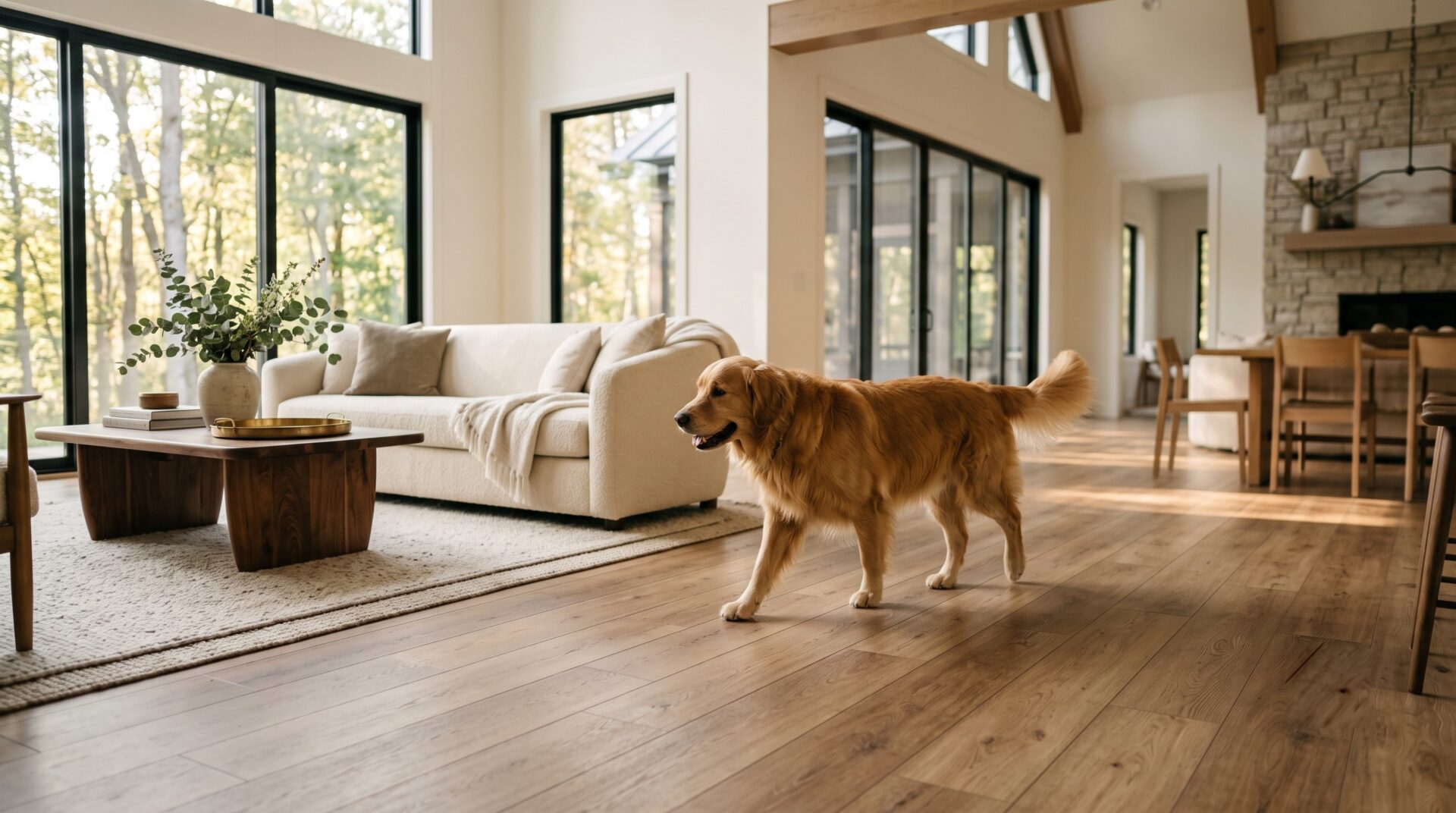
Your dog doesn’t know what your floors cost. That’s a fact most pet owners figure out the hard way – after the third scratch or the first accident you didn’t catch in time. In West Michigan, there’s an extra wrinkle most national flooring guides skip entirely: six months of road salt, slush, and calcium chloride tracked in on four paws from October through April. That combination makes the flooring decision here genuinely different from what you’d find in Nashville or Phoenix.
We’ve been fitting Grand Rapids homes with floors since 1963 – Forest Hills custom builds, Wyoming split-levels, Caledonia lake houses – and pet questions come up in nearly every consultation. Here’s the honest breakdown, without the marketing language.
Why Grand Rapids Dogs Are Harder on Floors Than the Ads Suggest
West Michigan winters do something no other region quite matches. Calcium chloride and magnesium chloride de-icers hit the roads by October and stay through March. Grand Rapids averages over 70 inches of snow annually, and those de-icing chemicals get tracked inside on every walk – dried to a white film on oil-finished hardwood, worked into seams on low-end laminate.
Here in Grand Rapids, the soil runs heavy with clay, particularly in older neighborhoods like Wyoming and Kentwood. Spring thaw pushes moisture through first floors and basements – relative humidity can reach 65-70% from March through June in those areas. For solid hardwood, that seasonal swing is a real threat.
The good news: the right floor handles all of this. The wrong one looks tired in three years.
Pro Tip from the DeHaan Team: Before any floor goes into a pet household, we check subfloor moisture. Grand Rapids homes built between 1950 and 1980 – especially in the Wyoming and Kentwood corridors – often show moisture readings that would void a solid hardwood manufacturer’s warranty before installation is even finished. That conversation is part of our free in-home estimate. The floor replacement isn’t.
The Salt Season Changes Your Decision Before Anything Else
October through March is when we field the most floor-damage calls from pet owners – not because of the dogs, but because of what they carry in. Oil-finished hardwood is the most vulnerable: it’s gorgeous when new, but it is not salt-resistant, and reapplication is a real maintenance commitment. Aluminum oxide and UV-cured finishes perform significantly better.
Low-end laminate is the other casualty. Repeated salt exposure and wet paws accelerate edge swell. The boards pull apart at the seams first. We see this regularly in Kentwood and Wyoming homes that went with box-store laminate five or six years ago.
LVP has no equivalent vulnerability. That’s not marketing – it’s chemistry. The core is stone-composite or fiberglass-reinforced, and neither reacts to chloride salts. Whatever is tracked in wipes off with a damp mop.
The Three Contenders: What Each One Actually Does in a Pet Household
Luxury Vinyl Plank: The Honest Winner for Most Pet Households
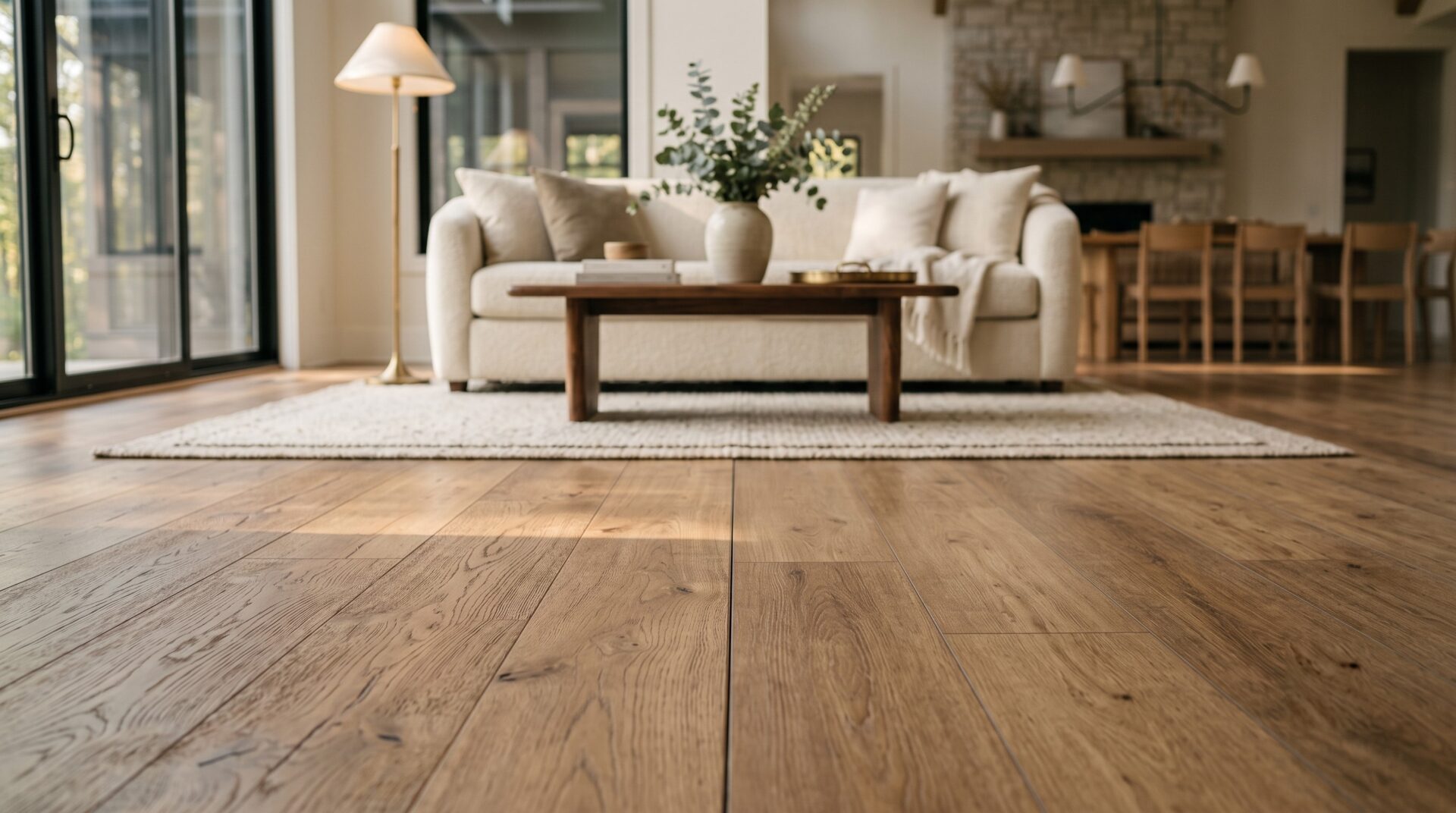
LVP is the right answer for most pet-owning homes. Not because it looks the most impressive in a showroom – hardwood still wins that comparison – but because it solves the actual problems dogs create.
Modern LVP from brands like COREtec, Mannington, and Quick-Step carries a wear layer between 12 and 20 mil. That wear layer determines scratch resistance, and a 20-mil wear layer significantly reduces visible dog nail scratching under normal conditions. More importantly, LVP with a waterproof core – like COREtec’s stone-composite construction – resists moisture penetration through the plank itself. An accident that sits overnight won’t penetrate to the subfloor. That’s a meaningful difference.
One important caveat: not all LVP is equal. Box-store products often use 6-8 mil wear layers. Ask specifically about wear layer thickness when comparing options – it’s the single most important specification for a pet household.
The aesthetic has come a long way. The better collections genuinely fool guests. Try the Roomvo Inspire tool to see how specific LVP styles look in your own room before you commit.
“I enjoyed working with the team at DeHaan. They were helpful in suggesting flooring options and patient as I brought samples back and forth to my home. The installers were very quick and efficient.”
– Grand Rapids-Area Homeowner | LVP Installation
Hardwood: Beautiful, But Conditional
We won’t tell you to skip hardwood because you have a dog. That’s an oversimplification. The right hardwood in the right home holds up better than people expect – with two conditions.
First, species hardness matters. The Janka hardness scale measures how much force it takes to embed a steel ball into a wood surface – a useful proxy for scratch resistance. Here’s how the common species compare:
| Wood Species | Janka Score | Pet Household Notes |
|---|---|---|
| Pine | 870 | Not recommended – too soft for dog nails |
| American Cherry | 995 | Soft – shows scratches quickly |
| American Walnut | 1,010 | Marginal – moderate pet traffic only |
| White Oak | 1,360 | Good choice – widely available, holds up well |
| White Ash | 1,320 | Good choice – similar to white oak |
| Hickory | 1,820 | Excellent – one of the hardest domestic species |
| Brazilian Walnut (Ipe) | 3,680+ | Very hard – durable but expansion/contraction requires care |
Second, finish matters as much as species. Wire-brushed and hand-scraped finishes hide surface scratches far better than a high-gloss smooth finish. Provenza and Mohawk both carry wire-brushed collections that work well in pet households.
Here’s the practical split: if you’re in a Forest Hills or Ada custom build with climate-controlled slab concrete and a dog that mostly stays on rugs, wire-brushed hardwood is a reasonable choice. If you’re in a 1960s Kentwood ranch with a clay subfloor and a German Shepherd that hits every corner at speed, LVP is the smarter call. We see the hardwood vs. LVP question constantly with clients in the Byron Center and Grandville area – and the answer depends less on the dog and more on the house.
Carpet: The Right Answer for Bedrooms
Carpet gets unfairly maligned in pet discussions. In bedrooms and low-traffic spaces where your dog sleeps more than it sprints, stain-resistant carpet from Karastan or Dreamweaver is genuinely comfortable, absorbs sound, and is far easier on aging dogs’ joints than hard surface floors.
Where carpet struggles is high-traffic areas with repeat accidents. The fiber can be cleaned, but if moisture reaches the pad and subfloor, the odor problem becomes structural.
The practical split that works for most pet households: LVP in the kitchen, mudroom, main living area, and anywhere near exterior doors. Carpet in bedrooms and finished basements that are genuinely dry and climate-controlled.
[NO MATCHING REVIEW FOUND – Please insert a genuine 4-5 star customer review referencing carpet, pets, or flooring durability before publishing]
How to Choose: A Simple Decision Guide
You have dogs, you live in Grand Rapids. Here’s the practical breakdown:
- Multiple large dogs or frequent accidents? LVP everywhere except bedrooms. No exceptions.
- One large dog, well-behaved, Forest Hills-style climate-controlled home? Wire-brushed hardwood in main areas is a reasonable choice.
- Smaller dogs (under 30 lbs) on mostly dry floors? Either hardwood or LVP works – let aesthetics lead.
- Retired dog or senior pet, mostly sleeps in bedrooms? Stain-resistant carpet in sleeping areas, LVP in kitchen and living areas.
- Basement or mudroom near an exterior door? LVP or porcelain tile. Never solid hardwood.
Our Shop-at-Home service lets one of our designers bring samples to your space so you can see how each option looks in your light, with your furniture, with your actual room conditions. That’s a better test than any showroom. Book online or call (616) 432-2318.
Maintenance Realities, Without the Marketing Spin
Honestly, “pet-proof” is marketing language. No floor is pet-proof. What varies is how much abuse each type absorbs before it shows it.
LVP: sweep or vacuum every few days to remove grit – grit is what creates micro-scratches, not the dog itself. Damp mop with a pH-neutral cleaner when needed. Avoid steam mops entirely – most LVP manufacturers, including COREtec and Mannington, explicitly void the warranty for steam mop use. The heat warps planks.
Hardwood: the grit principle applies even more urgently. Small stones in dog paws act like sandpaper on hardwood finish. High-quality mats at every exterior door matter. Regular nail trims protect both your floors and your dog’s joint health.
Carpet: vacuum twice weekly in pet areas. Address accidents immediately with an enzyme-based cleaner to break down protein before it sets. Annual professional cleaning is not optional if you have indoor pets.
Frequently Asked Questions
What is the best flooring for dogs in Grand Rapids?
For most Grand Rapids households with dogs, waterproof LVP from brands like COREtec or Mannington is the best choice. It handles dog nails, moisture, and Michigan road salt better than hardwood, laminate, or standard carpet. Wire-brushed hardwood from white oak or hickory is a reasonable alternative in climate-controlled homes with well-behaved dogs.
Does LVP scratch from dog nails?
LVP with a 20-mil or higher wear layer significantly reduces visible dog nail scratching under normal conditions. Lower wear-layer products (6-8 mil, common at big-box stores) will show scratches faster. Ask specifically about wear layer thickness when comparing products – it’s the single most important specification for a pet household.
Can I have hardwood floors with a large dog?
Yes, with the right species and finish. Hickory (Janka 1,820), white oak (1,360), and white ash (1,320) hold up significantly better under dog nails than softer species. Wire-brushed and hand-scraped finishes hide surface marks far better than smooth high-gloss options. Avoid oil-finished hardwood in high-traffic pet areas.
Does road salt damage flooring?
It can. Calcium chloride and magnesium chloride dry to a residue that dulls oil-finished hardwood over time and accelerates seam failure in low-end laminate. LVP and aluminum oxide-finished hardwood are the most salt-resistant options for West Michigan winters.
Is carpet a good choice for pet owners?
Carpet is a strong choice in bedrooms and low-traffic areas where pets sleep. In kitchens, mudrooms, and living areas with high pet traffic, LVP outperforms carpet for moisture and odor control. Stain-resistant collections from Karastan and Dreamweaver perform best in pet households.
Ready to Find the Right Floor for Your Home and Your Dog?
Stop by our showroom at 6522 Division Ave S, Grand Rapids – we carry samples from every major flooring category, and our team asks the right questions before making a recommendation. Or book a Shop-at-Home visit and we’ll bring the samples to you.
Call us at (616) 432-2318 or book online. No pressure, no surprises – just honest advice from a locally owned team that’s been fitting West Michigan homes since 1963.
- carpet
- durable flooring
- floors for pets
- hardwood flooring
- luxury vinyl flooring
- LVP